
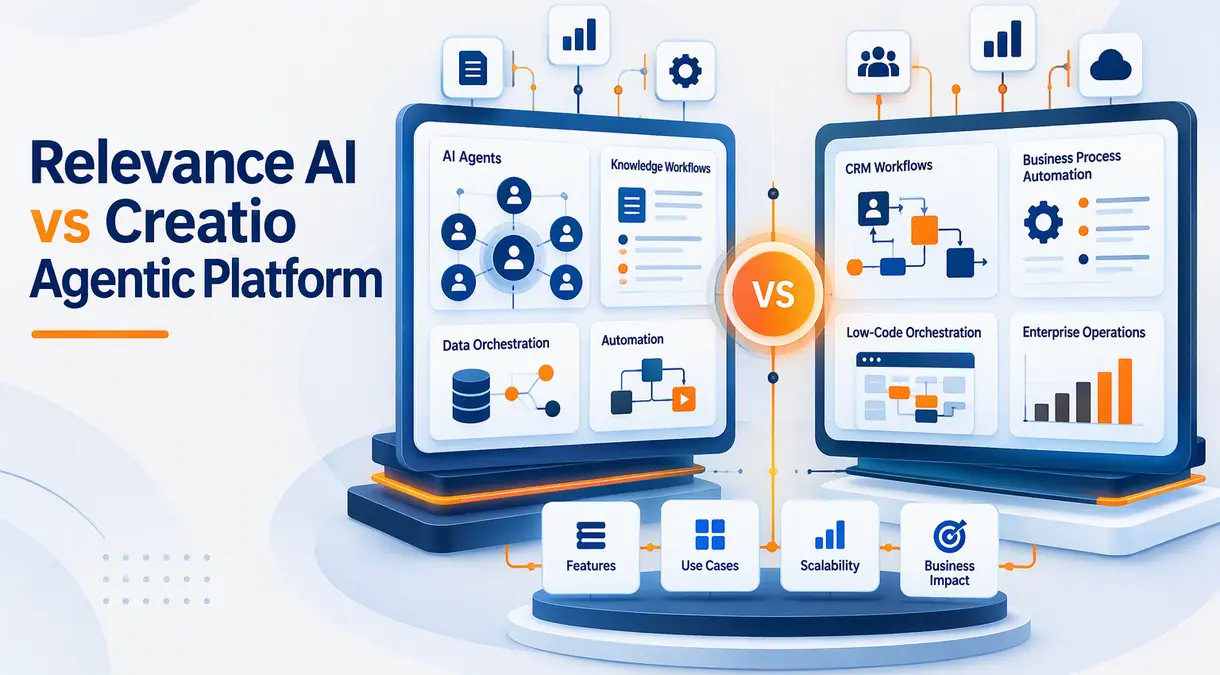
The use of artificial intelligence is altering how companies automate processes and workflows, enhance customer experiences, and optimize operations. Rather than just implementing conventional automation, most organizations are increasingly implementing agentic AI platforms, capable of performing tasks, making decisions, and working alongside people. Relevance AI and Creatio Agentic Platform are the most used among the rising number of AI automation platforms that are growing in popularity among businesses seeking to deploy intelligent workflows.
Both sites are dedicated to AI-driven automation, but they have somewhat different functions. Relevance AI focuses on the creation of AI agents and automating business processes with little code, and Creatio integrates AI with its no-code CRM and workflow automation solution. The decision between the two will be determined by the objectives of my organization, technical considerations, and current business processes.
In this comparison, I will describe how both Relevance AI and Creatio Agentic Platform operate, what they share and have in common, what their advantages and disadvantages are, and assist in choosing which platform will be the most suitable and fit various business requirements.
What is Relevance AI?
Relevance AI is an AI automation platform tool that enables business organizations to develop smart AI agents without necessarily possessing in-depth knowledge of the programming language. It also allows users to develop their own AI-powered processes that can serve customer support, conduct research, provide sales support, perform data analysis, provide data documentation services, and automate business processes.
The platform offers visual tools that enable the building of AI agents easily, and it can be used by startups, marketing teams, customer support departments, and other businesses interested in automating knowledge-intensive work. Relevance AI is a system that enables organizations to save on manual efforts by connecting with various business applications, enabling them to boost productivity.
What Is Creatio Agentic Platform?
Under Creatio, Creatio Agentic Platform is one of the larger parts of a no-code automation ecosystem. It integrates customer relationship management (CRM), business process automation, and AI-driven agents on one platform.
Creatio does not just sit back and wait for AI assistants to solve the issue, but helps organizations automate all end-to-end workflows in sales, marketing, customer care, and operations. With its no-code platform, it enables business users to create applications and automate intricate workflows without the need to know how to write software.
Enterprises that already have CRM systems or aim for digital transformation: an alternative CRM solution, Creatio, is offered to them as a combination of AI and process automation.
Relevance AI vs Creatio Agentic Platform: Key Differences
Even though both websites promote automation powered by AI, their main priorities are different.
Relevance AI focuses on creating autonomous AI agents that can handle certain business functions, including answering questions, summarizing documents, producing reports, or helping employees with tasks such as repetitive work.
Instead, Creatio Agentic Platform brings AI abilities to more comprehensive enterprise workflow automation. It is an integration of CRM, business process management, and AI agents, which is why it is especially alluring to companies that require one common platform that will enable business operations.
Consequently, Relevance AI can be more oriented toward the team of AI productivity, and Creatio is oriented toward the organization, which is looking to automate large-scale processes.
Feature Comparison
AI Agent Development
Relevance AI is specialized in building customized AI agents via visual interfaces. Consumers are able to create agents that engage with business data, automate research, create content, or help internal teams.
Creatio is also AI-agent friendly but is incorporated directly into CRM and workflow automation scenarios. This will enable AI to integrate into larger business processes, instead of operating independently as assistants.
Workflow Automation
One of these growing strengths of Creatio is workflow automation.
The platform can be used by businesses to automate their sales pipelines, customer support requests, approvals, marketing, and operational processes via its no-code workflow builder.
Relevance AI also, like Automation, enables automation, but is more about AI-assisted execution of tasks, as opposed to full enterprise task management.
Ease of Use
The two platforms have been created to minimize the programming requirement.
Relevance AI has a simple design, enabling people to create AI agents comparatively fast, so it is appropriate for non-technical teams playing with AI automation.
Creatio is also a no-code development platform with additional enterprise-level settings. Although this offers more flexibility, more planning and implementation may be needed with complex organizations.
Integrations
The requirements of an AI platform are integration capabilities.
Relevance AI supports other well-known business applications, databases, APIs, and productivity applications to assist AI agents in gaining access to organizational knowledge and automated workflows.
Creatio is also compatible with CRM programs, business enterprise software, cloud computing, communications, and third-party business sites and, as such, is a good fit for companies that operate a wide variety of business systems.
Analytics and Reporting
Both sites offer reporting features but with a difference in focus.
Relevance AI focuses on AI performance, workflow output, and business insight that aids businesses in optimizing agent behavior over time.
Creatio is an integration of AI analytics and CRM reporting, customer insights, sales dashboards, and operational metrics, offering a more expansive business intelligence view.
Relevance AI vs Creatio: Pros and Cons
Relevance AI Advantages
It has a number of advantages for organizations that implement AI automation.
Its visual AI agent builder allows non-technical users to create agents, and flexible integrations enable businesses to automate a great number of tasks. The platform specifically succeeds in knowledge management, document analysis, customer support, and research workflows.
Nevertheless, Relevance AI might have to be integrated with other software to be used by businesses that require a full CRM or enterprise process management solution.
Creatio Agentic Platform Advantages
The uniqueness of Creatio lies in the ability to work with AI automation and the CRM with no-code application development.
Companies are able to automate customer experiences, sales, marketing, and internal operations from a central platform. Its business orientation also aids governance, scalability, and optimization of business processes.
The extended feature list, though, can be a steeper learning curve for smaller groups who simply need lightweight AI automation.
Which Businesses Should Choose Relevance AI?
Relevance AI will be optimally applied to startups, growing companies, consulting firms, marketing agencies, research teams, and organizations who would like to implement AI assistants rapidly without developing complex enterprise systems.
If my main goal is to come up with AI agents that do repetitive work, generate summaries, respond to queries, and enhance productivity during work in a team, Relevance AI is an excellent and versatile solution.
Which Businesses Should Choose Creatio Agentic Platform?
Creatio is more suited to medium- and large-scale companies in need of a full-scale digital transformation.
Companies requiring CRM, workflow automation, customer service management, and AI features in a single platform will have more advantages with Creatio. The automation capabilities of its enterprise-grade platform can also be valued by businesses having several departments and complicated approval procedures.
Pricing Considerations
Both platforms usually have tailored pricing models depending on the size of the business, required features, and the needs of deployment.
Relevance AI typically provides people, startups, and expanding organizations with options for a modular plan that scales with small implementation before going big.
Creatio focuses on enterprise buyers, with pricing based on broader CRM functionality, workflow automation, and enhanced business process solutions. The cost of licensing, requirements to implement, and scalability over the long term are some of the factors that businesses should weigh prior to choosing whether to use one or the other platform.
Best Practices for Choosing Between Relevance AI and Creatio
I have to determine my main business goal before choosing a platform. Relevance AI could offer a quicker implementation route than my objective, which is to deploy AI agents in a timely and effective manner to achieve productivity and automation.
When my organization needs workflow automation on an enterprise scale, CRM, and end-to-end business process management, Creatio will probably be a better option. The type of integration needs, user adoption, scalability, and the degree of technical resources can be considered to ensure that the chosen platform is appropriate to the long-term business objectives.
Conclusion
Relevance AI and Creatio Agentic Platform provide similar AI-driven automation, although in different scenarios. Relevance AI is a promising alternative choice since it revolves around creating smart AI agents that automate knowledge-based work and repetitive tasks with minimal coding, which makes it an appealing option to those teams willing to adopt AI at a fast pace.
Creatio Agentic Platform, in turn, is a hybrid of artificial intelligence and CRM, as well as no-code development and enterprise-level workflow automation, suited to businesses of greater scope in terms of their digital transformation efforts. Organizations can select the platform that most easily incorporates the automation strategy by considering the business requirements carefully, existing technology infrastructure, and future growth plans.
Also Read: Mobile Virtual Network Operator (MVNO): Everything You Need to Know
About the Author
