
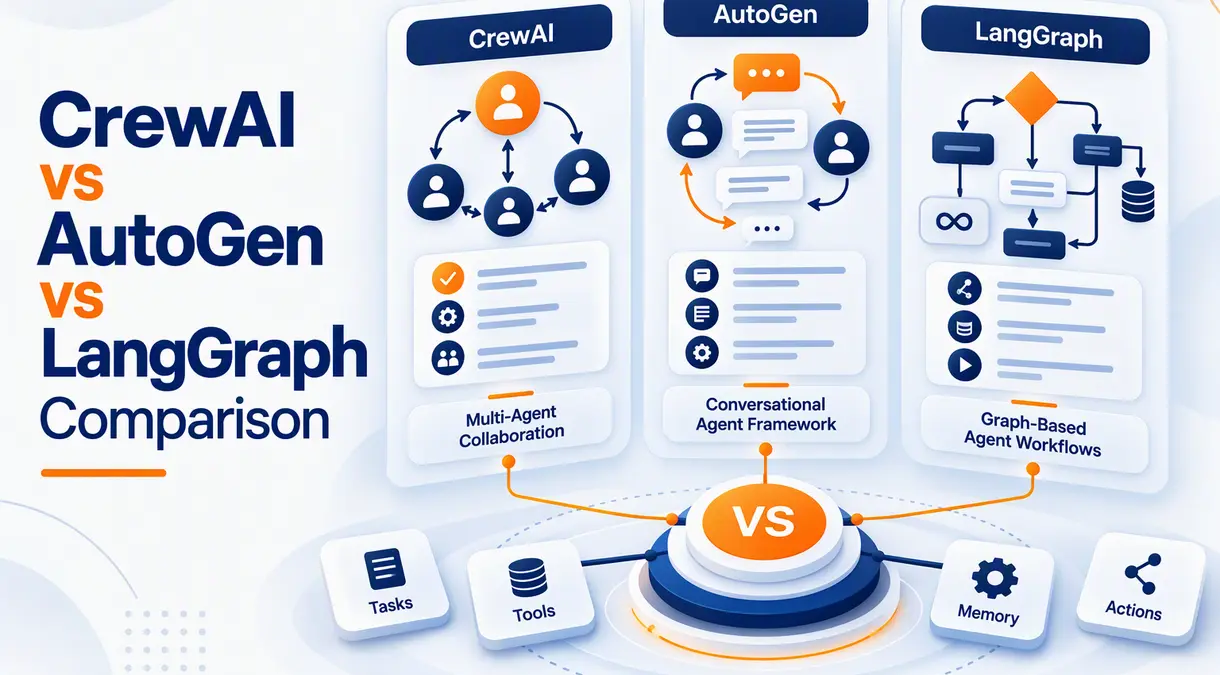
With the ever-growing capabilities of AI agents, developers and businesses are no longer developing separate pieces of chatbots, but rather developing systems where two or more AI agents collaborate to solve more intricate problems. These multi-agent AI systems are enabled, however, by the possibility of automating research, software development, customer support, data analysis, and enterprise workflows by having AI agents communicate and collaborate with each other.
CrewAI, AutoGen, and LangGraph are considered to be some of the most prominent models in this field. As much as they all support agent-based AI applications, they vary greatly in their architecture, flexibility, ease of use, and best-case scenario. Depending on the selection of speedy growth, current level of coordination to the enterprise, or a very adaptable workflow makes the selection of an appropriate framework.
As one of the components of this comparison, I will discuss how CrewAI, AutoGen, and LangGraph work, control them in terms of functionality, discuss their pros and cons, and contribute to the selection of the most suitable framework in relation to certain AI development projects.
What is CrewAI?
CrewAI is a free-source framework that aims to create collaborative AI teams that comprise two or more agents to carry out duties. The role of AI agents is defined, and they may be researchers, writers, reviewers, or planners, thus allowing work to be shared, as is the case in a human team.
CrewAI is relatively easy to understand and implement, as it is a role-based approach. The developers can define the responsibilities of the agents, workflows, tools, and communication patterns, and this can be clearly done in a well-organized project.
Due to its simplicity and modularity, CrewAI is frequently used in AI assistants, automation of research, content generation, and business workflow automation.
What is AutoGen?
AutoGen is a single free multi-agent system developed by Microsoft to enable AI agents to interact and cooperate in solving problems in complex environments.
AutoGen is more focused on dialogue between two or more agents than the presentation of a rigid workflow. Ranging from basic values like simple communication agents to high-level functions like code inspection and even human assistance, agents interact with each other, checking and verifying one another, creating code, executing functions, and even obtaining human assistance where it is required.
AutoGen is particularly beneficial in this conversational architecture and focuses on software development, code generation, debugging, collaborative assistance in reasoning, and research-intensive applications.
What is LangGraph?
LangGraph is a system that is built on the LangChain ecosystem to create stateful, graph-based AI agent workflows.
LangGraph is an excellent method of AI interaction compared to CrewAI or AutoGen since it represents AI interactions as items connected together by a directed graph. The technology allows the computationalists to prepare intricate work processes with conditional logic, looping, contingent execution, memory management, and enduring conditions of applications.
LangGraph is especially applicable in systems associated with enterprise AI in which there is a requirement for complex orchestration and labor-intensive work processes.
CrewAI vs AutoGen vs LangGraph: Core Differences
Although the three frameworks are all supportive of different AI agents, they are different in their philosophies.
CrewAI focuses on collaboration as a role, and it becomes simple to delegate roles to various AI agents undertaking a common goal.
AutoGen is an agent-based approach, and thus many AI models engage in dialogues that provide each other with information and address issues in a dynamic manner.
The workflow coordination of LangGraph has been highlighted, where agent interactions are modeled as graph processes that run with state and ad hoc execution paths.
These differences apply to architectural aspects such as scalability, customization, and the type of application each framework can support.
Feature Comparison
Ease of Learning
CrewAI is the simplest framework to start with in general, as the role structure of the framework is similar to the real-life team structure. Developers can acquire knowledge incredibly quickly of how the different agents can interact in order to accomplish anything that they are tasked to do.
AutoGen is even more complex since it is conversational and yet welcoming to Python and AI API professional developers.
The steepest learning curve is in LangGraph, where it has a graph-based structure and workflow management abilities. However, more elaborate projects become more flexible due to the sophistication.
Multi-Agent Collaboration
CrewAI excels at structured collaboration wherein each agent is assigned a designated role, and each agent forwards a role to another agent.
AutoGen provides a more dynamic interaction by enabling agents to interact freely, discuss solutions, and hone them until they have a satisfactory answer.
LangGraph encourages both structured and dynamic collaboration where the developers in charge of the execution of the workflow are entrusted with everything, as the graph orchestration is in charge.
Workflow Management
LangGraph is a coordination of the workflow.
The developers can build sophisticated AI systems that have been trained to divide, retry, loop, human-approval loops, channel retention, and lengthy processes.
CrewAI helps to coordinate work processes, but concentrates more on sequential collaboration rather than on enterprise orchestration.
AutoGen allows flexibility in conversations but needs more customization to accommodate more structured workflows.
Memory and State Management
A high-level state manager, which is appropriate when an application has long-term memory and in which processes are long-running, is LangGraph.
The CrewAI assists in sharing the context among the agents and is usually tuned to functions with shorter collaborative tasks.
AutoGen enables conversational context to be remembered during agent interactions, but in practice, state management at large scale needs extra implementation.
Integration Capabilities
Three different frameworks combine with large language models and outside tools, and there are variations in the ecosystem.
CrewAI is compatible with search engines and productivity applications, APIs, and databases.
AutoGen can be coded into Python applications, is amenable to developer-friendly coding environments, and is preferred by software engineers because of this.
Large LangChain can benefit LangGraph, providing developers with access to numerous database, subscription, and dashboard integrations, retrieval systems, and API and enterprise application integrations.
Performance Comparison
CrewAI is competent in regular business processes, where the functions are structured, and creating it wholeheartedly is less complicated.
AutoGen is advanced in challenging reasoning scenarios where more than two AI agents are able to discuss and develop ideas by comprehending dialogues.
LangGraph can be scaled to high levels and can even handle workflow, stateful orchestration, and fine control of execution paths in an application with the necessities of an enterprise.
Performance is highly dependent on the complexities and construction of the application being discussed instead of the superiority of one framework over the other.
Pros and Cons
CrewAI Advantages
CrewAI is easy to use, lightweight, and user-friendly. Its AI collaboration is also intuitive and highly efficient in terms of the complexity of development. It can particularly be used in business automation, research assistants, as well as content generators.
Complex workflows or state management, though, may eventually surpass the less complex architecture of CrewAI.
AutoGen Advantages
AutoGen has unparalleled collaborative reasoning and software development flexibility. A number of AI agents can discuss each other naturally as they revise, refine, and correct one another.
The first shortcoming is that conversational workflows can be tough to coordinate at the scale of the application, at least without some additional coordination.
LangGraph Advantages
LangGraph offers conditional workflow and orchestration at an enterprise level, persistent states, and high-level customization.
It is very flexible and can be utilized in sophisticated AI systems, though the developers should expect a more complex learning curve and expensive implementation when compared to both CrewAI and AutoGen.
Which Framework Should You Choose?
In my cases where I must formulate AI teams and I am in a rush, and it is not that complicated, I tend to begin with CrewAI. Its role-based approach is organized to require less development and enables numerous typical business automation situations.
AutoGen can be a very powerful tool in the case that I need AI agents that can communicate with each other through talking, particularly in software engineering, debugging, or computation problems.
LangGraph is the most general and can be extended to the use of longer workflows, more heavyweight orchestration, memory persistence, and complex business activities.
Best Practices When Selecting an AI Framework
To select a framework, I will consider the complexity of my project, the experience of my development team, and the amount of customization of the workflow. The success of implementing a framework with a shorter implementation time is more likely for a simpler project, whereas enterprise systems are likely to require more capabilities to design the entire orchestration.
The integration requirements, support to the community, quality of documentation, and scale in the future should also be considered. Whichever new framework is selected, depending on the long-term business objectives, the redevelopment can be reduced to the minimal possible amount in the context of the ever-growing number of AI applications.
Conclusion
CrewAI, AutoGen, and LangGraph are variants of multi-agent AI system construction. CrewAI is all about organizing these agents into teamwork, AutoGen is all about discussions between intelligent agents, and LangGraph provides advanced graph orchestration for enterprise workflows.
The proper option will always be based on the needs of the project. CrewAI is simple and quicker to deploy, AutoGen allows development teams to create collaborative AI systems, and LangGraph is likely to be the most competent solution to help enterprises with advanced workflow controls and scalability.
Also Read: Manus AI Review for Business Use: Features, Pricing & Pros
About the Author
