
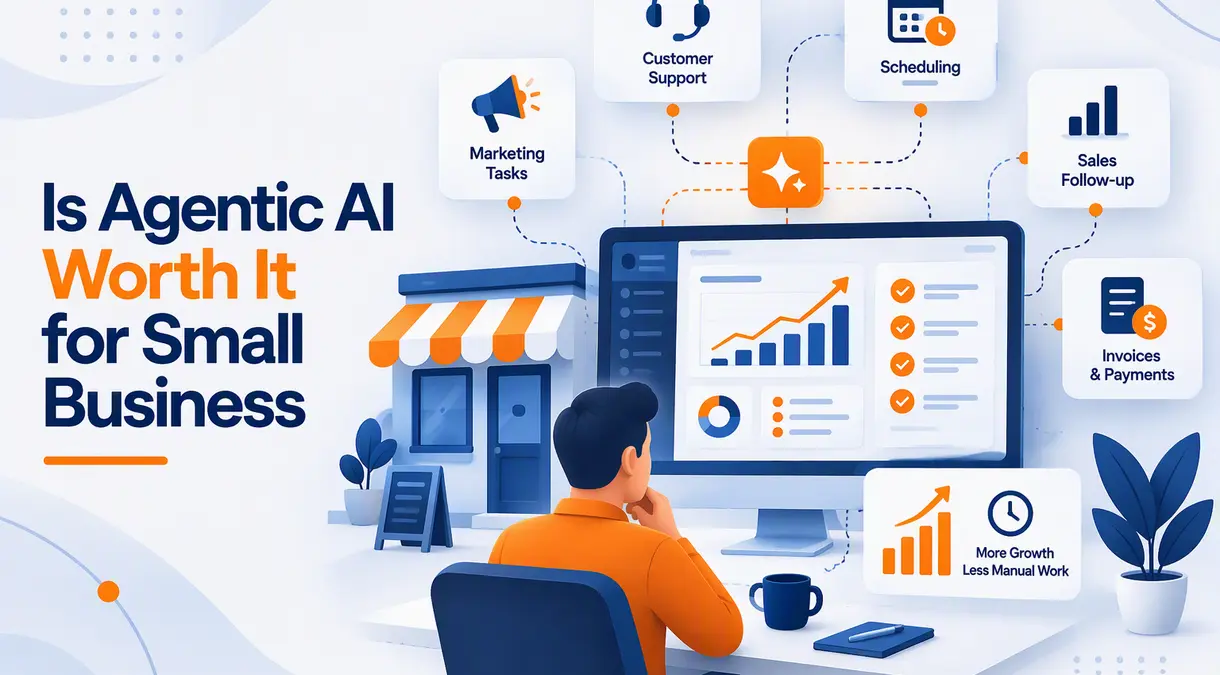
Small businesses are getting even more access to artificial intelligence. Rather than applying AI to simply write an email or involve content generation, businesses may now apply agentic AI to multi-step tasks, decision-making, using software, and completing a workflow with minimal human guidance.
However, to a small business owner, the question is not whether or not the agentic AI is impressive. Whether it is worthwhile and whether it is worth it. Assuming that an AI agent can either save multiple hours per week, respond to customers more quickly, or help them avoid repetitive administrative tasks, it may bring about significant value. Unless it must be watched over all the time, or its results are unreliable, however, it may not be worth adopting.
Here, I am going to consider the practical value of agentic AI to a small business, the benefits, the cost, the ways it can be used, the risks, and how to assess whether it is worthwhile for my business.
What Is Agentic AI?
The term agentic AI describes AI systems that are capable of comprehending objectives, task planning, tool utilization, decision-making, and acting. In contrast to a simple chatbot that carries out its tasks by awaiting instructions at each stage, an AI agent might actually be involved in the entire process with the minimal involvement of humans.
Stated differently, rather than requesting an AI to write me a customer email, I might send an inquiry to an agent, request the agent to review an incoming query, determine the needs of the customer, search and validate required information, write me a customer email, update my CRM, and alert me that I need to engage a human.
This renders agentic AI especially beneficial to workflows that comprise multiple interconnected steps in contrast to a solitary operation.
Why Are Small Businesses Interested in Agentic AI?
Small businesses can have a small staff. There can be owners and employees who combine customer service, sales, marketing, administration, scheduling, and other tasks.
The solution to this is agentic AI that can be used to supersede selected repetitive tasks. It does not necessarily mean that they should replace employees, less time should be devoted to routine work and more to customers, sales, and other strategic issues by a small team.
In its recommendations, the U.S. Small Business Administration advises small businesses to begin with practical AI applications and consider whether the technology really increases efficiency or customer service.
Where Can Agentic AI Help?
Customer Support
One of the most feasible applications of AI agents is that of customer support. A software can respond to common queries, find facts, classify queries, and forward complex problems to a human worker.
This can be of particular use to a small business, especially outside working hours. By eliminating the need to have a worker watch all messages on the web, customers are able to promptly get answers to common questions.
Lead Qualification
Incoming leads can be handled using AI agents as well. The agent might check the requests, choose the possible customers, gather some simple data, and prepare messages to be sent out.
I would not necessarily leave the agent to make all sales decisions on its own. A more effective way to do it is to leave it to do the first stage, which is repetitive, and forward any valuable or unusual leads to a salesperson to look at.
Administrative Work
The amount of time spent on administrative issues in a small business is surprisingly large. The agents can help in sorting emails, writing reports, summarising documents, updating records, and making appointments.
These activities in themselves might not provide direct revenue, but a decrease in their duration could enable the staff to spend more time on more valuable activities.
Marketing
The possible support of marketing through agentic AI includes researching competitors, generating content concepts, writing drafts of campaigns, summarizing performance data, and planning customer data.
I would also go through marketing content and then publish it. AI may become a source of wrong data or materials that do not correspond to a company’s brand.
Is Agentic AI Affordable for Small Businesses?
The response is dependent on the workflow and platform.
Certain AI agent platforms provide comparatively low-priced subscriptions, whereas others charge depending on usage, activities, model use, or integrations. The subscription is not the only expense that I should take into account.
The overall cost can also be influenced by setup time, training of employees, integrations, monitoring, and human review. In the case of a small business, time going into configuring and troubleshooting an agent can even prove more valuable than an agent software subscription.
That is why I would take care to know the cost divided by measurable time or money saved, or not, in comparison to the monthly price.
What Are the Risks?
Compared to a simple chatbot, agentic AI can pose a greater risk since it might be given authorization to act.
When an agent gains access to a CRM, email address, financial data, or database of customers, a wrong choice may result in actual business issues. Access controls, privacy, as well as security gain importance.
The SBA also advises avoiding desensitization to AI results and knowing some pitfalls to avoid when using AI in business.
I would begin by providing an agent with restricted access and having human authorization for key actions like handling finances, modifying customers’ account details, or handling sensitive messages.
When Is Agentic AI Worth It?
The most likely task that agentic AI is worthy of is a task that is common, regular, quantifiable, and somewhat predictable.
As an illustration, processes that handle multiple customer queries per day that are similar tend to be better use cases than automating a high-scale strategic decision that is made only twice a year.
A 2026 survey of adoption of agentic AI in small and medium-sized businesses also indicates that a practical starting point can be offered by controlled, partial autonomy with simple and medium-complexity processes.
When Is It Not Worth It?
I would not embrace using agentic AI just because other competitors are doing it.
In case my business contains a very small amount of repeatable processes, slow transaction numbers, or constantly changing process workflows, conventional automation or a generic AI assistant might suffice.
Dangerous applications: Agentic AI is also inappropriate when there would be severe financial, legal, or reputational ramifications of a failure, unless agencies employ powerful human controls.
How Should a Small Business Get Started?
I would not begin with attempting to automate the whole business since this would need a long time to do so.
To elaborate on this, I would say to an AI agent to manage sales, where I would rather request it to check on new website inquiries, categorize them, set qualified leads in the CRM, and draft a follow-up email to be sent upon my approval.
This method simplifies the measurement of the results and minimizes the amount of harm that can be caused by failures.
How to Measure ROI
An example of a few metrics I would monitor prior to implementing an AI agent includes, but is not limited to:
- Hours saved each week
- Cost per completed task
- Response time
- Error rate
- Number of tasks completed
- Human intervention required
- Revenue or conversions influenced
One should not just save time without creating more errors or reducing customer satisfaction due to the AI. Improved business is the focus, not increased automation.
Final Verdict
Yes, agentic AI may be valuable to small businesses, but only when it implements the appropriate workflows.
Dubious processes like customer support, lead qualification, research, scheduling, reporting, and administrative work are the most advantageous uses. Such activities may eat up a lot of employee time and still adhere to fairly predictable patterns.
Nevertheless, I would not consider an AI agent a full-scale substitute for an employee and leave it to do its job. It is more prudent to begin small, restrict its approvals, have humanity participate in key decision-making, and measure the outcomes.
The most appropriate agentic AI approach to a small business does not always include the implementation of the most sophisticated AI system. It is discovering one hypnotic process with which the automation will conserve time, lessen expenses, or enhance customer satisfaction, and demonstrating that it works first and then scaling up.
Also Read: What Is a Good CTR?
About the Author
