
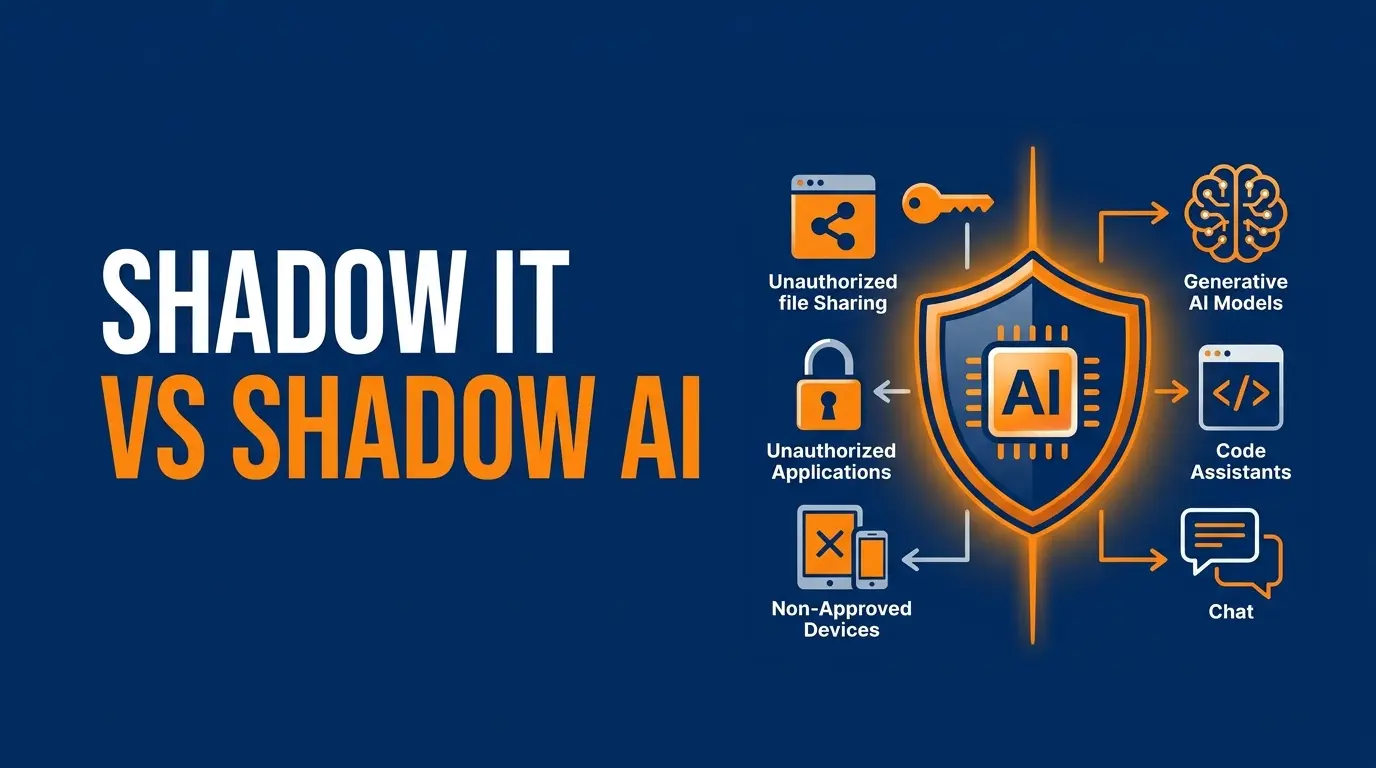
With the trend of increasing cloud software and artificial intelligence use by businesses, employees are using technology without having to go through an official IT or procurement process. This practice is referred to as Shadow IT. More recently, the accelerated use of generative AI has led to a more specific group known as Shadow AI.
The two concepts are similar but not identical, though they are related. Shadow IT is a wide concept that encompasses any unauthorized and/or unmanaged technology, whereas Shadow AI is a subset that requires the use of artificial-intelligence products, models, APIs, and AI-enabled services without recognized organizational approvals.
The difference in risk is important since it is a matter of the difference between the risks. Shadow IT may bring about issues of unlicensed software, unmonitored data, security, and compliance. Shadow AI presents most of those risks, coupled with worries about sensitive information feeding into AI models, uncontrolled usage costs, generated content, AI behavior, API usage, and AI privacy and governance demands.
What Is Shadow IT?
Shadow IT is considered technology, software, applications, devices, or cloud-based services that employees utilize without the consent or information of an IT department of an organization.
When an employee finds it hard to use the official company tool, he/she may subscribe to a project-management application. A marketing team might use a corporate card to buy a different analytics platform. One of the developers may install an application on a cloud service without the knowledge of the infrastructure team.
The technology need not be bad or purposefully unauthorized. In most instances, employees use tools because they feel that these tools will enable them to have an easier time working.
An example of this is that an employee may use:
- An unapproved file-sharing platform
- A personal cloud-storage account
- An unofficial project-management application
- A browser extension
- A messaging service
- An external CRM
- A personal SaaS subscription
- An unauthorized cloud environment
What Is Shadow AI?
Shadow AI represents a subset of Shadow IT using artificial intelligence.
It arises when employees access AI-related tools, AI platforms, APIs, models, or AI-based services by bypassing organizational formal AI governance, security, procurement, or compliance mechanisms.
Examples include when employees individually utilize:
- ChatGPT
- Claude
- Gemini
- Perplexity
- AI coding assistants
- AI image generators
- AI transcription tools
- AI meeting assistants
- AI writing platforms
- AI research tools
- AI APIs
- AI browser extensions
An employee may add a company document into a chatbot powered by AI to summarize it without being aware that the information may be leaked to policies that the company has given.
An AI API may also be tied to an internal application by a developer without notifying security teams.
An AI can be used by a sales employee who uploads information about a customer in order to draw a tailored proposal.
Such actions may pose hazards at the expense of the employee who may well intend to do good.
Shadow IT vs Shadow AI: The Key Difference
The easiest one is:
The wider term is Shadow IT. Its category specific to AI is shadow AI.
Shadow IT may include literally any unlicensed technology.
Shadow AI is about AI technology in particular.
This implies that any Shadow AI might be regarded as Shadow IT, though not everything Shadow IT qualifies as Shadow AI.
An example of Shadow IT is when an employee utilizes an illegal CRM.
Shadow AI is when an employee uses an AI-powered CRM that has not been approved by their employer or uploads his/her customers’ information to an external AI assistant.
Shadow IT vs Shadow AI Comparison
| Factor | Shadow IT | Shadow AI |
| Definition | Unmanaged technology | Unmanaged AI technology |
| Scope | Broad | AI-specific |
| Examples | SaaS, cloud tools, devices | Chatbots, AI agents, AI APIs |
| Data risk | High | Often higher |
| Cost risk | Subscription costs | Subscriptions + usage costs |
| Security risk | Unauthorized applications | AI data exposure + application risks |
| Privacy concerns | Data stored in external tools | Data sent to AI models |
| Usage visibility | Often difficult | Often extremely difficult |
| Governance | IT governance | AI + IT governance |
| Main challenge | Discovering unauthorized technology | Controlling AI use and consumption |
Why Shadow AI Is Different
AI Can Process Sensitive Information
The type of data that employees can provide can be considered one of the largest differences.
Conventional Shadow IT could be storing a spreadsheet in an unauthorized application.
Shadow AI can be when the contents of that spreadsheet are sent to an AI model to analyze.
The employee might be unaware of the fact that information is passing through another security barrier. Organizations should be aware of how prompts, uploaded files, output, and account data are managed depending on the service and configuration.
This is what renders AI governance especially significant in a business that deals with confidential customer, employee, financial, legal, or even proprietary data.
AI Can Make Decisions or Generate Content
Conventional software tends to execute pre-destined tasks.
AI systems have the ability to produce text, code, images, recommendations, classifications, summaries, and more.
That poses further governance questions:
- Is the information that is produced correct?
- Is it dependable to make crucial decisions with employees?
- Is there any confidential information in the output?
- Who answers in case the AI comes up with a wrong answer?
- Are there weaknesses in the code generated by AI?
- Is the AI system approved for the particular business use case?
All these complicate Shadow AI, beyond having to find unauthorized SaaS.
Security Risks of Shadow IT
Shadow IT is capable of causing a number of typical security issues.
Hacker apps can access business information without undergoing security checks. Employees are allowed to use the same passwords, link applications to company accounts, or leave sensitive data with vendors without prior evaluation by the security staff.
It can also have difficulties with:
- Unapproved integrations
- Excessive permissions
- Data leakage
- Weak authentication
- Poor vendor security
- Unmanaged devices
- Compliance violations
- Expired subscriptions
- Unknown cloud environments
Security Risks of Shadow AI
Shadow AI inherits these risks and introduces AI-specific risks.
An employee has no idea that they are forwarding confidential information to a third-party model. An API key can be exposed by a developer. Information can be stored longer than anticipated by an AI application. When an AI-generated recommendation is actually full of mistakes, it may be viewed as true.
There can also be risks involving:
- Prompt injection
- Sensitive-data leakage
- Insecure AI integrations
- Excessive agent permissions
- AI-generated malicious or vulnerable code
- Unapproved AI models
- Third-party model dependencies
- Unpredictable API consumption
Another issue involves AI agents due to the possibility of them performing actions as opposed to merely rendering text. An agent can interact with files, databases, APIs, and external systems based on their construction.
Thus, an uncontrolled AI agent has the potential to be both a data-security threat and an operational threat.
How Businesses Can Control Shadow IT
The answer to Shadow IT is not always prohibiting all the applications that employees come across.
Organizations ought to develop a smoother approved channel.
An efficient procedure comprises:
Create an Approved Software List
Employees are to be aware of the available tools that are already approved. When there are useful alternatives that employees can access without hardship, they are less inclined to go around IT.
Centralize Procurement
There should be clear ownership and approval requirements for purchases. Finance and IT ought to be in a position to know the software being acquired and the reason.
Discover Existing Tools
Identify already entered applications by use of SSO, accounting data, expense systems, browser or endpoint information, and SaaS management platforms.
Review Usage Regularly
Extra applications ought to be eliminated, redundant tools should be shared, and significant software ought to be allocated owners.
How Businesses Can Control Shadow AI
Shadow AI involves all the above and an AI-specific policy architecture.
Companies ought to have policies regarding:
- Approved AI tools
- Prohibited AI use cases
- Confidential information
- Customer data
- AI-generated code
- API credentials
- AI agents
- Human review requirements
- AI spending limits
- Model selection
- Vendor security
Nonetheless, policies cannot be used on their own.
Businesses also need to check what AI tools employees are utilizing, how much the company is paying, and whether sensitive information is being forwarded to services that are not approved.
The idea is not to disallow employees from experimenting with AI. Positive productivity solutions can be created with the aid of AI. This is aimed at making experimentation transparent, regulated, and cost-effective.
Final Verdict
Shadow IT and Shadow AI are finally a question of breadth and focus.
Shadow IT is the wide-ranging occurrence of employees utilizing technology without an official appearance or endorsement of the owners. And, Shadow AI is the AI-specific form of that behavior, and includes chatbots, AI assistants, AI APIs, AI agents, and AI-powered applications.
Characteristic issues of Shadow IT include software that has been installed without authorization, lack of security, and redundancies in subscriptions and uncontrolled access to data. Shadow AI brings these along with AI-specific data privacy issues, unpredictable consumption costs, model risks, generated-content issues, and ever-more autonomous software agents.
In the case of small businesses, adopting AI is not to be prohibited. Alternatively, develop an accepted AI toolkit, develop defined data policies, centralize purchasing, track AI and SaaS expenses, and periodically take a look at what workers are actually working with.
The best approach is to ensure that the approved path is not more difficult than the shadow one. Organizations can gain the productivity that AI can provide before organizations see Shadow AI grow into a runaway security or budget disaster by providing employees with fast access to safe, valuable, and low-priced AI tools.
Also Read: AI Cost Trap SaaS Explained: Hidden Costs, Usage Pricing & How to Avoid Them
About the Author
