
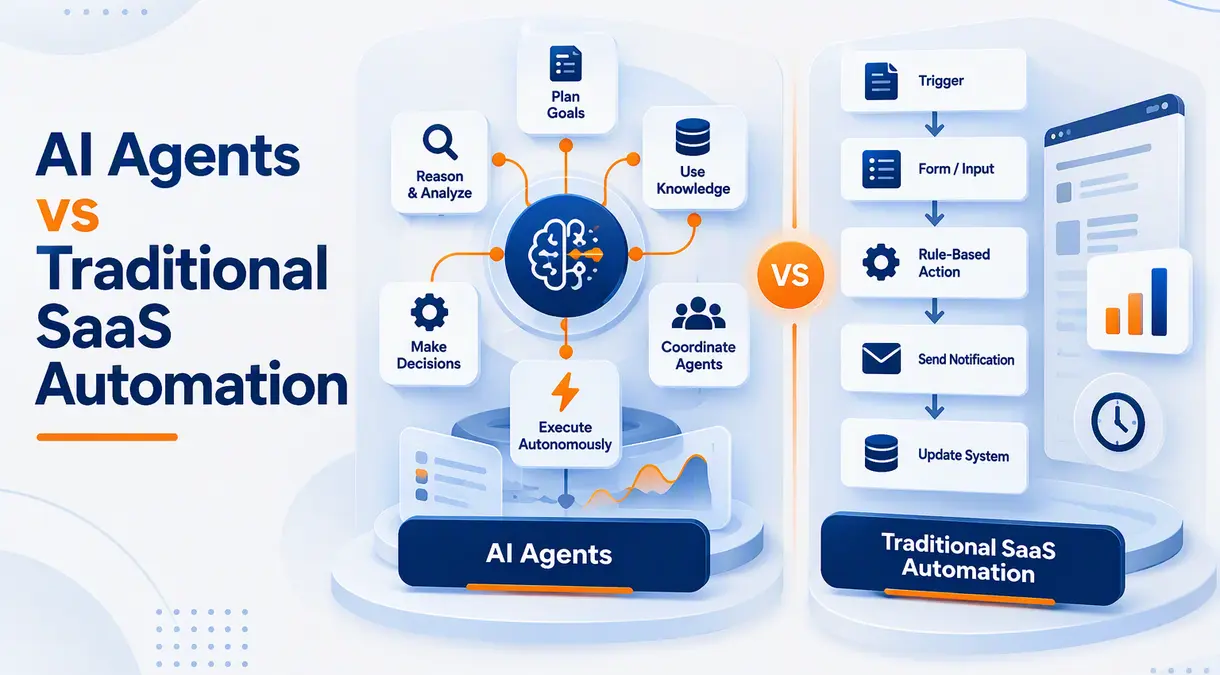
SaaS automation is not a new finding for businesses, since it has been used over the years to automate repetitive business processes such as CRM updates, email marketing, accounting, and customer support workflows. These have assisted in cutting manual work and enhancing efficiency.
Today, AI agents are modifying expectations. They are more flexible in their duties rather than just adhering to established regulations, as they are able to interpret objectives, decide, and respond in multi-step operations. According to Microsoft, AI agents are systems capable of performing actions to achieve objectives, whereas traditional automation relies on pre-defined rules.
This does not imply the absence of SaaS automation by AI agents. More often than not, a combination of both is the best solution. I will dissect the distinctions, strengths, and optimal applications of each in this article.
What Is Traditional SaaS Automation?
Conventional SaaS automation involves maintaining software regulations and impeccable workflows alongside automated execution of particular tasks by software. For example, I can build a workflow that will go through something like: when a customer fills out a form, add the contact to my CRM, send him/her a welcome email, and inform the sales team.
Foreseeability is the benefit. The repetition of the same input should be followed by the repetition of the sequence of actions that the automation should undertake. This is why the use of conventional automation is especially efficient when it comes to processes that have guidelines, organized information, and can be easily predicted. IBM observes that classic automation fits very well in monotonous activities that have a standard design.
What Are AI Agents?
AI agents are programs that operate with the purpose of attaining objectives through interpretation of data, decision-making, the utilization of tools, and actions. Instead of programming all possible conditions on a computer, an agent is free to apply an AI model and see what actions could be right for the situation.
To demonstrate it, rather than develop dozens of rules to address customer inquiries, I could provide an AI agent with a collection of a knowledge base, CRM, email system, and ticketing platform. The customer’s request could be comprehended by the agent, who could decide whether they could answer the question, find and retrieve information, update the ticket, and escalate the matter if necessary. The capability of planning and implementing multi-step tasks is one of the main differences compared to traditional automation.
AI Agents vs Traditional SaaS Automation: Key Difference
The easiest paradigm for comprehending the difference is rules versus goals.
Conventional SaaS automation normally poses the question, “What is to happen in the event that this condition is met? The users of an AI are more goal-focused: “In order to attain this goal, what should be happening? Such a difference is significant when the process is ambiguous, or circumstances arise unforeseen.
Legacy processes demand that companies predict the states of affairs and specify the behavior that the software must portray. AI agents are able to understand the context and dynamically choose the actions of the tools and permissions that they have received. According to IBM, agentic workflows are dynamic systems that are responsive to real-time and unforeseen situations.
Flexibility and Adaptability
The classic automation is stable yet inflexible. When it falls beyond what is defined in the rules, I must either update the workflow or do it manually.
AI agents are more flexible as they are able to process unstructured data and adapt their behaviors depending on the situation. Nevertheless, this range presents variability in results.
Complexity of Tasks
Standard automation is effective, especially when handling simple tasks like transferring data between applications, sending notifications, allocating tickets, or updating records.
It is more interesting that AI agents are needed when a process has several steps and interpretation is needed. An example would be an agent conducting research on a potential customer, summarizing information about the company, finding relevant products, writing a personalized outreach email, and subsequently adding the findings into a CRM. The sequence can change precisely depending on the discovery made by the agent.
It does not imply that all the multi-step processes require an AI agent. In a predictable sequence, conventional automation can still be less complex and costly and more stable.
Accuracy and Predictability
The main automation is very predictable. I have an idea of what to expect if I set a rule.
The AIs are probabilistic. They are able to read between the lines, yet they might fail to comprehend or give erroneous outcomes. That is why it is essential to govern and supervise people, which is the case with Microsoft.
Setup and Maintenance
The old-fashioned automation may require time to get configured, as all the rules and exceptions have to be specified.
With natural-language instructions, AI agents can reduce some of the effort necessary to set up the system, yet they do not eliminate testing, monitoring, permissions, and safeguards. According to IBM, agent systems cause increased complexity in operation as they are dynamic in nature.
Cost Considerations
Most conventional SaaS automation tends to follow predictable per-user, per-workflow, or per-task pricing models.
The use of AI agents can have variable costs based on the use of the model, tool calls, and execution time. They might also need further investment in monitoring and supervision.
Rather than just comparing the raw subscription fees, it is preferable to consider the price per successful outcome.
Security and Control
Conventional automation is a form of control that is strict, as all the activities are pre-programmed.
The use of AI agents should be controlled more closely, as it has the capability to select among different tools and actions. This augments scoped access and monitoring requirements and governance as a way of minimizing risk.
Where Traditional SaaS Automation Is Better
Most business processes are still inclined to traditional forms of automation.
To the extent that my workflow is repetitive, predictable, governed by rules, and can be described by an if-this, then-that logic, there might be little motive to add an AI agent. Deterministic automation can be very useful in payroll processing, periodic notifications, data synchronization, invoice reminders, and simple CRM updates.
It is also logical that being predictable and doing something that can be audited counts more than being flexible. It can be a significant benefit in regulated or high-risk processes to know precisely what a system will do.
Where AI Agents Are Better
When the workflow is characterized by uncertainty, raw data, fluid conditions, or numerous potential paths, AI agents prove to be more valuable.
A good example is that of customer support. A classical workflow can be used to redirect tickets, depending on keywords and defined categories. An AI agent will be able to gather the intent of the customer, get information, make a decision on what tools to apply, do multiple actions, and pass the case to the next stage in case of reaching the boundaries of its authority.
The agentic approach can also be applied in research, sales qualification, document analysis, internal knowledge management, and intricate customer operations. Among the points that Microsoft sees as significant to the differences between agents and traditional automation are multi-step tasks and adaptive decision-making.
AI Agents vs Traditional SaaS Automation: Comparison
Factor AI Agents Conventional SaaS Automation.
| Factor | AI Agents | Traditional SaaS Automation |
|---|---|---|
| Decision-making | Dynamic | Rule-based |
| Flexibility | High | Limited to configured rules |
| Predictability | Lower | High |
| Best for | Complex, variable workflows | Repetitive, predictable tasks |
| Setup | Natural-language/configuration + testing | Workflow and rule configuration |
| Data type | Structured + unstructured | Primarily structured |
| Human oversight | Often recommended | Usually lower |
| Cost predictability | Can vary | Generally more predictable |
| Error handling | Can adapt, but may make mistakes | Follows predefined exceptions |
| Governance complexity | Higher | Generally simpler |
Should Businesses Replace SaaS Automation With AI Agents?
I do not believe that traditional automation should be substituted with the new one by business owners only because AI agents are more recent.
More suitable would be to consider one workflow at a time. When a process is predictable and is explainable in terms of rules, traditional automation is usually the logical decision. An AI agent can be more helpful in case the process needs interpretation, research, judgment, or the active selection of dynamic tools.
A hybrid model will probably be the most feasible in most instances. Tasks that involve precision can be tackled by deterministic automation, whereas ambiguous decisions or unstructured inputs can be tackled by an AI agent, and then the result is passed to a standard workflow. The latest agentic workflow discussions exhibit a similar trend to emphasize hybrid systems that are based on deterministic steps and decisions enabled by AI.
How to Decide Which One You Need
I would begin by writing down the process that I would like to automate. Then I would ask: are the steps always the same, are the inputs organized, are there frequent exceptions, and what happens when the system has gone wrong?
With these types of questions being answered, SaaS automation can possibly be sufficient. When the employees have to constantly decode information and think about the next step, an AI agent will be a more attractive solution.
I would also not grant an agent access to critical systems but instead just give them a small pilot. A more objective view of whether the agentic automation is in fact generating value is the time saved, error rates, completion rates, and human intervention.
Final Verdict
AI agents do not necessarily compete with traditional SaaS automation. They are solutions to various degrees of the automation issue.
Conventional SaaS automation can still be very good in situations where there may be predictable, repetitive processes, and my issue is that I need reliability and to control the process accurately. Computer-based AI agents are more appropriate for work streams needing logical reasoning, contextual knowledge, versatility, and parallel decision-making.
A hybrid approach between the two could thus be the most effective business automation approach in 2026. Traditional automation can be applied to deterministic tasks, and AI agents where flexibility can actually pay off. Rather than posing the question, Should I replace my automation with AI? it is better to ask, Which aspects of this workflow need intelligence and which aspects of this workflow need dependable performance?
Also Read: Best Agentic AI Platforms 2026: Top Tools Compared
About the Author
