
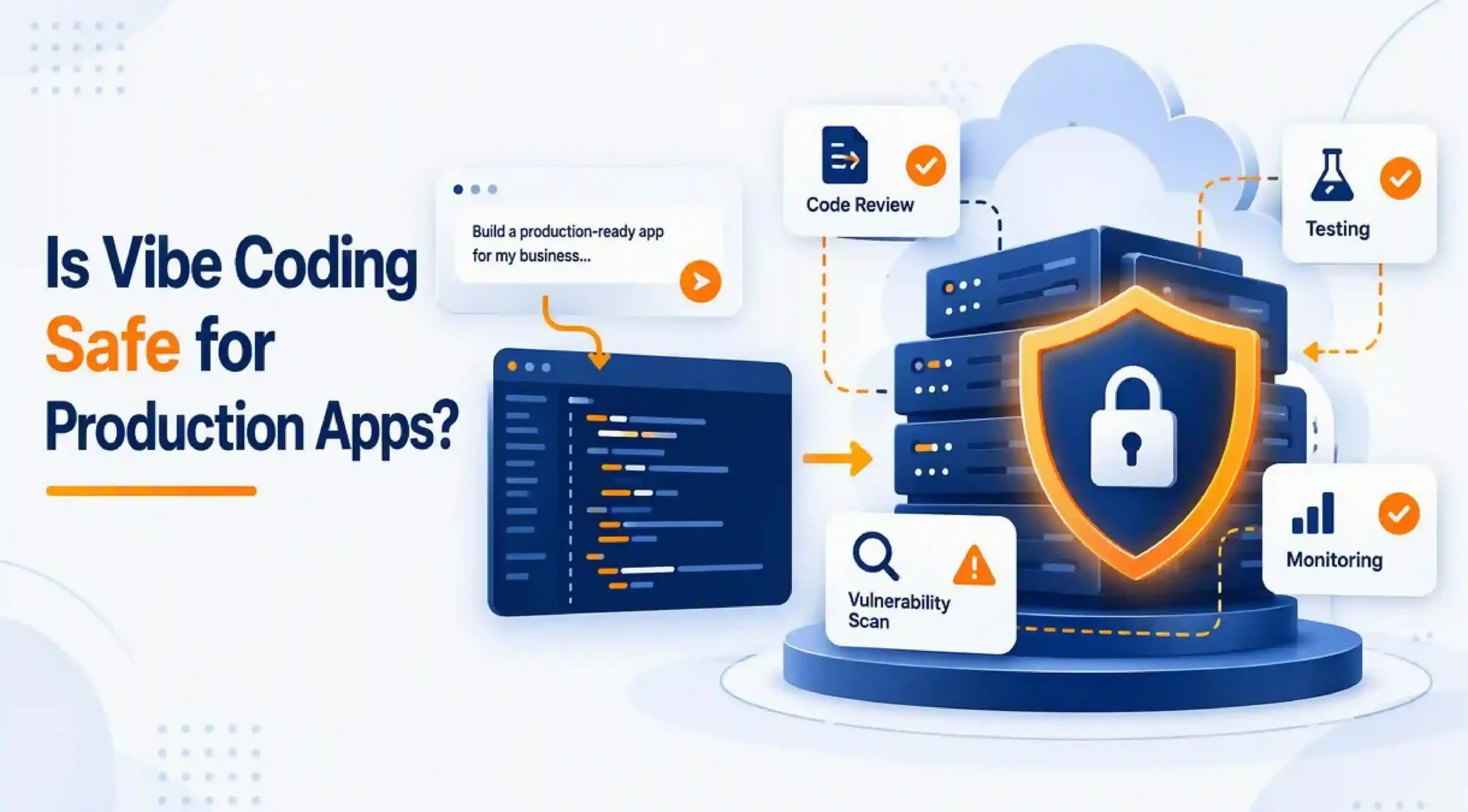
Vibe coding has revolutionized software development for developers. Rather than typing all functions, developers can specify what they desire in natural language and create, edit, test, and debug the program using AI code generators. State-of-the-art AI code assistants and agentic development tools have the ability to generate entire features, work across files, find bugs, and even aid programmers in deploying applications. This speeds up development much faster, especially when utilizing startups, independent developers, and small teams.
But the question related to speed is: is vibe coding safe when it comes to production apps? Yes, although it requires AI-generated code to be treated with the equivalent engineering rigor as old-fashioned written code. Vibe coding will be a nice method to get faster production development, yet placing AI on autopilot and applying it without prior testing, security data review, and human control can cause some severe issues. Implementation with the utilization of AI, but with architecture, security, testing, and final approval under high human control, is the safest approach.
What Is Vibe Coding?
Vibe coding is a development method that uses AI to help create an application or feature by developers stating they want something in natural language and letting an AI system create much of the code. A developer could tell an AI agent to develop a user authentication system, integrate it with a database, create an API, build the frontend interface, and write tests instead of manually creating each of these components.
The coding agents developed today can do so much beyond autocomplete. They are able to view an existing codebase, create and update files, install dependencies, run commands, run tests, diagnose errors, and make changes in a complete project, depending on the tool’s permissions. Vibe coding is highly productive, which is made possible, however, by the fact that it requires developers to be aware of what the AI is up to instead of presuming that generated code is automatically trustworthy.
Why Vibe Coding Can Be Safe for Production
The code generated by AI does not necessarily pose a threat to security or be unsuitable for use in production. Applied as a part of a formal engineering process, it can assist developers in creating production-quality software more quickly. AI is especially handy with repetitive work in implementation, boilerplate code, API integrations, database work, frontend, documentation, and automated tests.
The other benefit is that AI enables developers to detect issues during development. It is able to check code, clarify unknown areas, propose improvements, generate extra Test Cases, and discover possible edge cases. This may be an extra support to development teams.
The key point is that AI must speed up the engineering process and not eliminate engineering. Whether the code to build a production application was created by an individual, an AI system, both together, or neither, a production application still needs architecture, security controls, testing, monitoring, and deployment processes and ongoing maintenance.
The Major Risks of Using Vibe Coding in Production
Security Vulnerabilities
The biggest danger will be that AI can write code that performs well, but still has security vulnerabilities. An authentication will, say, be effective in providing users access to accounts, yet fail to provide adequate safeguards for some of the API endpoints. On the same note, an artificial intelligence-based application may authenticate normal user input and fail to notice an abnormal attack case.
Examples of common risks are SQL injection, cross-site scripting, insecure authentication, broken authorization, exposed API endpoints, insecure file uploads, weak access controls, hardcoded credentials, and improperly set security headers. These problems may prove hard to detect merely by considering whether or not the application works.
Security testing of AI must then occur in isolation of the AI generation process to be applied in production. Static analysis, dependency scanning, secret finding, penetration testing as needed, and manual security verification are still significant.
Unnecessary Dependencies and Technical Debt
Vibe coding can also prompt developers to add packages and libraries anytime a new requirement is discovered. An AI agent can also rapidly install a dependency to address a particular issue, despite the capability to implement the functionality being available inside the project.
In the long run, it may lead to unjustified dependencies, far-flung patterns of implementation, old libraries, and technical debt. Developers ought to know why each dependency is present, and they should constantly check packages to find vulnerabilities, their maintenance status, licensing, and compatibility.
Poor Architecture
AI can solve individual programming problems quite well, yet solving an individual problem does not mean designing an excellent software architecture. Unless developers set up architectural limits, the project may slowly turn into a maintenance nightmare, as they keep requesting an AI to add features without clearly defining what is within and outside its reach.
The outcome might also be code repetition, bloated components, non-uniform APIs, weak database relationships, unwarranted abstractions, and tightly coupled services. The app may be functional early, but as it develops, it would be harder to adapt.
This is why developers need to set the architecture, data model, code standards, and technology decisions of the application and then request AI to create large amounts of code.
Secrets and Production Credentials
Another high risk can be the case of freely providing an AI coding agent with access to sensitive credentials. The production database passwords, cloud credentials, private keys, payment credentials, and API secrets must not be carelessly disclosed to development agents.
An alternative and safer method is separate development and production environments, limited permissions, temporary credentials, secret-management systems, and sandboxed environments. An AI agent must have general access only to the resources necessary to its assigned task.
How to Make Vibe-Coded Apps Production Safe
Start With a Clear Architecture
Define the basic architecture of the application before it produces large volumes of code. Determine authentication, business logic, database structure, APIs exposed, deployment of the application, etc.
These restrictions would give the AI more consistent output and would decrease the chances of having the project turned into a haphazard assortment of resulting code.
Break Development Into Small Tasks
Instead of asking an AI agent to create a complete production application in a single prompt, break down the work into small, manageable features. Authentication, database, payment processing, user management, notifications, and reporting should be developed and reviewed independently.
Smaller changes can be grasped more easily, unexpected behavior can be detected, potential security implications can be examined, and problematic changes can be reversed.
Use Automated Testing and Security Checks
Automated tests on the key functionality should be provided to the production applications. Single functions can be checked with unit tests, interactions between components can be checked with integration tests, and end-to-end tests can be used to ensure that significant user workflows are working.
The development pipeline should also include security and quality tools. Issues that AI-generated tests might miss can be identified with dependency scanning, secret scanning, static analysis, vulnerability detection, and proper security testing. Testing can catch problems that AI-generated tests may overlook.
Require Human Code Review
One of the most crucial measures of AI-generated software protection is human scrutiny. Significant changes need to pass through the developers, and they must be aware of the rationale and implications of the changes.
That is not to verify the code generated by an AI one character at a time. Rather, developers ought to have the capability of describing the architecture, data flow, security model, dependencies, and, in general, critical business logic in a manner sufficient to assume responsibility for the application.
Deploy Through Staging
The code generated by AI should generally go through a staging environment prior to going to production. Staging can be used to authenticate, debug, test database migrations, integrations, configuration, performance, and test real-world user workflows without directly impacting production users.
A reliable deployment process should therefore follow a path such as AI development → automated tests → security checks → human review → staging → QA → production.
Which Production Apps Are Suitable for Vibe Coding?
The use of vibe coding is especially good in comparatively simple applications like internal dashboards, marketing sites, prototypes, administration applications, content sites, simple SaaS software, and business automation systems. A significant amount of the implementation can be left to AI as the developers concentrate on the requirements and quality control of the products.
More care is required with applications of financial transactions, healthcare information, identity management, highly sensitive personal data, government systems, or other high-impact functionality. AI can play a significant role in these projects as well, although it would act as an accelerator in an accepted engineering and security paradigm and not be an independent developer.
Final Verdict: Is Vibe Coding Safe for Production?
Production apps can be safe with vibe coding, although this is only under proper engineering controls of AI-written code. The fallacy is believing that the code is safe merely because it compiles, because the interface is well-defined and clean, or because the application is passing a low level of testing.
AI has the potential to slash the development period by a significant proportion; nonetheless, it does not eliminate the requirement for architecture, security, testing, code review, monitoring, backup, and discipline in deployment. Human architecture, AI-assisted implementation, automated testing, security scanning, staging, and human approval are the most reliable model of production.
That is, developers must make use of AI aggressively to enhance productivity and be conservative in allowing permissions and approvals of changes in production. Vibe coding is not a software engineering replacement, but a potent new method of software engineering. By keeping that difference, one can transition AI-generated applications to production without compromising their reliability, security, or maintainability.
Also Read: Best Vibe Coding Tools for Mobile Apps in 2026
About the Author
