
Vibe coding is no longer just AI autocomplete. Complex computer programs can comprehend an entire project, prepare multi-step updates, formulate files, execute commands, test applications, and refine their output. Now Salesforce is introducing that practice into its ecosystem with Agentforce Vibes.
However, is Agentforce Vibes a real contender to tools like Cursor, Replit, Claude Code, and other AI development tools? Or is it more of a niche offer to Salesforce developers?
Having considered its abilities, operations, pricing, security design, and limitations, the answer is quite obvious: Agentforce Vibes would be more attractive to teams that work within Salesforce, whereas general-purpose developers would find other vibe-coding options more adaptable.
What Is Agentforce Vibes?
Salesforce has created an AI-driven Software Development Environment, thought to be called Agentforce Vibes, to develop agentic software. It enables users to write natural-language specifications of what they desire, and write, debug, test, and deploy software using an AI agent to do the planning.
Salesforce outlines it as a set of tools for AI development, which may be integrated with Salesforce agents, web applications, mobile applications, Salesforce metadata, Apex, Lightning Web Components, workflows, and so forth.
The platform currently consists of two primary experiences:
- Agentforce Vibes IDE — a browser-based VS Code environment designed for Salesforce development.
- Agentforce Vibes VS Code Extension — an extension that brings agentic Salesforce development into desktop VS Code.
It is noteworthy that this is a difference. In no way is Agentforce Vibes any chatbot creating snippets of code. It is built to act as an agentic development system that has the capability to comprehend project context and execute multi-step development tasks.
How Does Agentforce Vibes Work?
The core workflow is conversational.
Instead of manually explaining every file that needs to change, you can describe the desired outcome.
For example:
Develop a customer service agent able to search an account, recognize outstanding cases, summarize the customer’s recent interactions, and send high-priority cases to the frontline.
The necessity can be converted into a development plan by Agentforce Vibes, and the necessary implementation can be created.
According to the documentation of Salesforce, the agent makes a plan ahead of time and identifies dependencies, follows the sequence of tasks, and then represents the goals, non-goals, and tasks prior to the changes. It could then make modifications or create files, execute commands, and implement metadata in the development environment.
This makes Agentforce Vibes fundamentally different from traditional autocomplete.
The basic concept is:
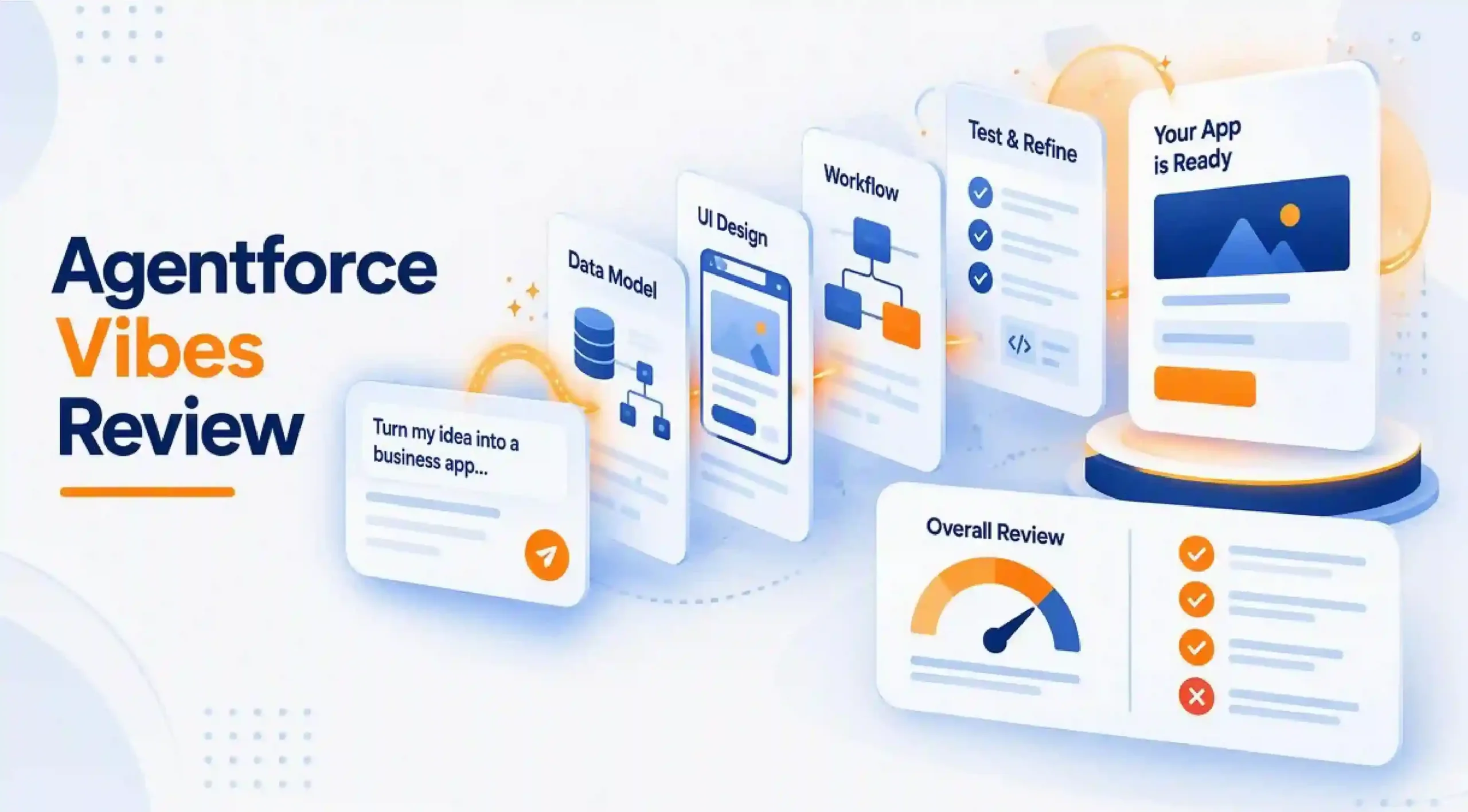
Prompt → Plan → Approve → Build → Test → Iterate
That is the core of modern agentic development.
What Can You Build With Agentforce Vibes?
Agentforce Vibes can be especially effective in cases involving Salesforce technologies.
It is able to create and process:
- Apex classes
- Apex triggers
- Apex tests
- Lightning Web Components
- UI elements
- Salesforce metadata
- Workflows
- Agentforce agents
- Business logic
- Web applications
- Mobile applications
- Existing Salesforce projects
Vibes in particular are positioned by Salesforce as the solution that allows both professional developers and low-code developers to take a step outside the conservative Salesforce development process.
And that renders it significantly broader than a mere Apex code generator.
As an example, a developer might request it to update an existing Lightning Web Component, write some supporting Apex code, test it, debug an error, and update the related metadata.
The value here is that it lets the AI act on a project-wide basis as opposed to handling each code-generation request as a single interaction.
Agentforce Vibes for Salesforce Developers
This is where the product would make the most sense.
Salesforce environments have the potential to get complex, as the behavior of applications is not stored in one codebase. Developers might be required to do it in Apex, Lightning components, metadata, objects, permissions, automation, agents, and Salesforce-specific configuration.
Much existing accessible work can possibly be removed by an AI agent sensing this ecosystem.
According to Salesforce documentation, Agentforce Vibes utilizes project context, metadata, and team coding standards to assist the agent in planning and executing development tasks.
To those who are experienced and develop Salesforce, this might translate to fewer hours of repetition in implementation and more hours reviewing architecture, business logic, security, and edge cases.
To Salesforce admins and low-code builders, this potential advantage is even more evident: natural-language instructions can be used to bridge the gap between a business requirement and a functioning Salesforce code.
Agentforce Vibes for Mobile and Web Apps
This makes it more ambitious than a traditional Salesforce development assistant.
Yet, this is the place where expectations should be realistic, too.
If the creation of a fully independent consumer mobile application is your main goal, the existence of specialized tools and development stacks can enhance the work process.
The Agentforce Vibes is far more convincing when the application requires making an in-depth connection with Salesforce information, agents, processes, or business operations.
The Salesforce ecosystem will not be a weakness but a strength in that case.
Agentforce Vibes becomes much more compelling when the application needs to connect deeply with Salesforce data, agents, workflows, or enterprise processes.
In that scenario, Salesforce’s ecosystem becomes an advantage rather than a limitation.
Agentforce Vibes Pricing
Pricing should also be taken into consideration since Agentforce Vibes has shifted to a consumption-based enterprise model.
Salesforce currently offers Agentforce Vibes through Flex Credits as well as a flat-fee option. Salesforce lists Flex Credits at $500 per 100,000 credits, while the flat-fee option is listed at $125 per user per month.
Seeing how the consumption model works is something to consider prior to investing in the platform. Different prompts, steps of planning, debugging, and agent behaviors can be involved in the development of AI. A predictable single monthly expense can thus be more desirable to teams that are intensively using Vibes.
Salesforce has also been shifting Agentforce Vibes to paid usage, and with more new models, one reviewing it now needs to verify the present-day commercial conditions rather than using old reviews.
Agentforce Vibes Pros
1. Excellent Salesforce Integration
This is certainly the greatest merit. Instead of viewing Salesforce as an external framework that Salesforce developers have to learn, Agentforce Vibes knows the conditions in which Salesforce developers operate.
2. Agentic Development
It is capable of planning and undertaking several-step development activities rather than merely fulfilling single lines of code.
3. Enterprise Security
The Salesforce governance model and the Einstein Trust Layer contribute to the product and its specific features, which help to attract especially organizations with stringent data and compliance needs.
4. Eases a variety of development activities
The platform is not restricted to generation but can generate, modify, debug, test, and deploy code and metadata.
5. Works in VS Code
Users already using VS Code do not have to leave their environment since Salesforce possesses a tailor-made extension, in addition to the online IDE.
Agentforce Vibes Cons
1. Salesforce-Centric
This is its greatest strength and greatest weakness. Unless you are developing a React Native startup, a Python backend, an indie game, or otherwise unrelated SaaS product, Agentforce Vibes might not immediately seem the most intuitive.
2. Harder to learn than basic AI Constructors
The Salesforce CLI and Salesforce have implied familiarity with VS Code and Salesforce CLI to develop Agentforce Vibes, but Salesforce itself requires familiarity with VS Code. It makes it less consumer-friendly than tools built around a walk-through tour of describing your app.
3. Pricing and Purchasing may be complex
The AI pricing by consumption is flexible and eases forecasting, but can complicate the forecasting of teams with predictable development usage.
4. AI Output is Still to be Reviewed
Vibes, like all serious vibe-coding tools, should not be used as an independent engineering-review substitute. Salesforce suggests using generated code with a review prior to deployment into production.
Is Agentforce Vibes Worth It?
No, for the appropriate user, yes.
As a Salesforce developer, Salesforce administrator, or enterprise architect, or simply a by-and-large heavy investor in the Salesforce platform, a more strategically interesting vibe-coding tool in 2026 is Agentforce Vibes.
The fact that it can produce code is not its greatest strength.
It is because the AI is capable of operating in a Salesforce context.
It means that metadata, project structure, agents, business processes, and Salesforce-specific development patterns can enter into development discussions.
To a developer who is constructing an application that is entirely independent, the equation becomes different. General-purpose AI development environments like Cursor, Replit, Claude Code, and others can be more flexible.
Final Verdict
No vibe-coding spongist is the greatest general-purpose vibe-coding resource – or it doesn’t have to be.
Enterprise Salesforce development is its actual power.
As a Salesforce team, agentic planning in combination with generated code, testing, deployment, Salesforce environment, and VS Code integration plus enterprise security make it a formidable productivity tool. Salesforce documentation currently outlines Vibes as being a platform capable of planning, executing in the development space, and traversing the multi-step operations instead of merely recommending code.
Other AI coding platforms will typically be simpler and more geared toward independent developers and startups developing within Salesforce.
Overall rating: 8.5/10
Salesforce developers: 9.5/10
Enterprise teams: 9/10
Admins/low-code builders: 8.5/10
General developers: 7/10
Independent app builders: 6.5/10
The bottom line is simple:
If Salesforce is your development environment, then Agentforce Vibes is worth consideration. As long as Salesforce is not in your stack, other vibe-coding tools are much better suited to you.
And that difference is what makes agentic development intriguing: Salesforce is not attempting to compete with the tools in the market that code AI, but instead it is applying agentic development to make its big enterprise platform far easier to code on.
Also Read: Banani vs. v0 for UI Design: Which AI Tool Should You Choose?
About the Author
