
Development of a web application previously demanded this: developers, databases, hosting configurations, and technical management. This has now become easy with AI app builders which allow users to write an app in plain language and automatically write the majority of the software.
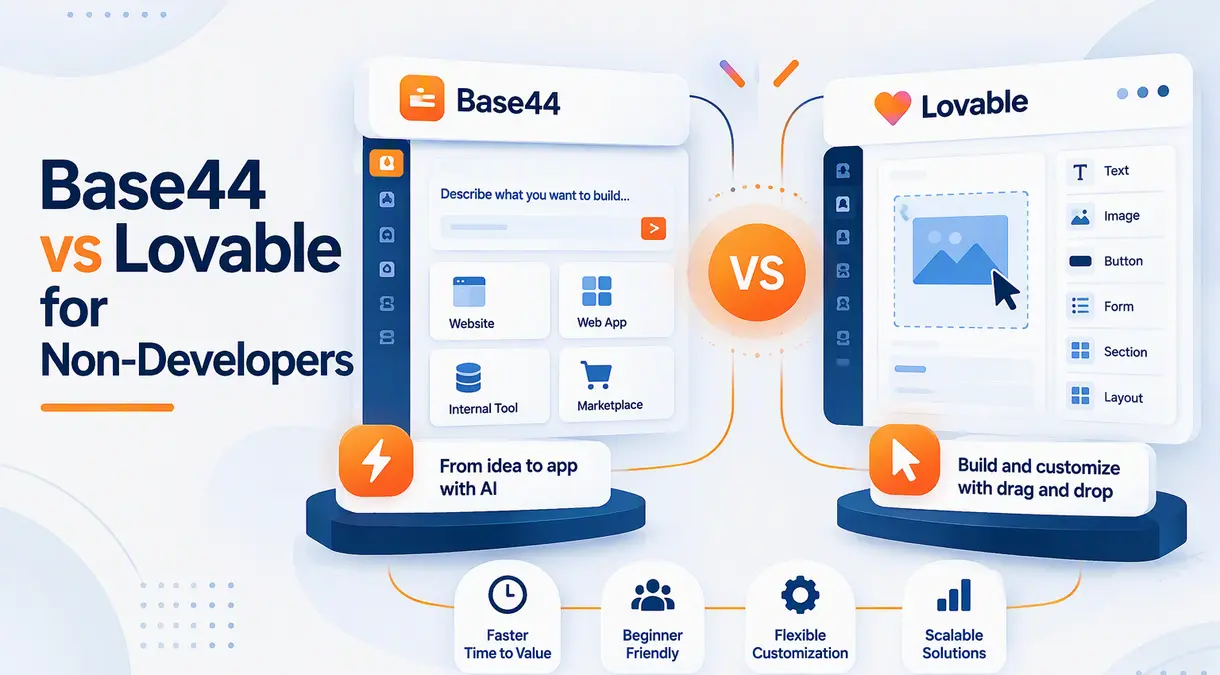
Two of the dominant tools in this area are Base44 and Lovable. They both allow me to create apps via conversation, yet they do this in different ways. Base44 targets an all-in-one managed system, whereas Lovable is a mixture of AI building and a more traditional and easy-to-develop stack.
It is not that, in the eyes of non-developers, it comes down only to the quality of output. The ease of use, backend support, integrations, ownership, pricing, and future scalability are all important.
The following comparison is Base44 vs. Lovable from the perspective of a non-developer.
What Is Base44?
Base44 is an AI application developer that translates natural-language prompts into complete applications. I am able to represent an idea, and it creates the UI, database, authentication, permissions, integrations, and deployment within a single platform.
This is particularly advantageous for novices, as I do not have to set up separate services such as hosting or databases.
It also provides various AI ways of building, planning, and editing, and makes it more conversational and easy to control.
What Is Lovable?
Lovable is a conversation-based AI software builder that builds websites and web apps. I am able to tell it what I desire and keep improving it with prompts.
One distinction is that Lovable is based on a more commodity development stack. It is compatible with GitHub and creates apps based on technologies such as React and TypeScript, and can use a backend based on Supabase or Lovable Cloud.
This can be more adaptable to longer-term development or passing the project to engineers in the future.
Base44 vs Lovable: The Biggest Difference
The difference can be thought of as simplicity versus portability.
Base44 aims to take care of virtually all my needs in a single controlled space. I am able to develop the app, authenticate, process data, integrate with other systems, and deploy it without knowing much about the underlying infrastructure.
Lovable also seeks to provide the accessibility of development, but it provides me with a more traditional application framework. This will be more flexible and have easier handoff to the developers though I will be facing more technical concepts as my project progresses.
Base44 may therefore be quite attractive to somebody who merely needs an internal working tool or prototype as fast as possible. However, when I am developing a project that I am likely to develop into a large-scale production, Lovable might be a more open approach over the long term.
Ease of Use for Non-Developers
Both tools are easy to use and use natural language.
Base44 helps lower the complexity of dealing with infrastructure by doing it automatically; hence, I do not have to consider databases or hosting.
Easy as well initially, but as the app expands, I will likely run into features such as GitHub, APIs, or backend services.
Building an App With Base44
Base44 lets me define an entire application: users, pages, data, and permissions, and spins up all of that in a single location.
It does well in dashboards, internal applications, or basic business applications since I do not require any external configuration.
The negative side is that I am more bound to the Base44 ecosystem, which can be an issue in case I wish to move in the future.
Building an App With Lovable
Lovable also does it by talking. I will be able to develop a webpage or application and make it more step-by-step optimal.
As an illustration, I can order a homepage, pricing page, a login system, a dashboard, and proceed further with upgrades.
A significant feature of it is its GitHub integration that enables them to access the underlying code and hand it off to developers.
Backend and Database
The difference between the platforms with regard to the importance of the backend functionality is one of the crucial ones.
Base44 offers a default database (based on the plan), authentication and permissions, and backend functions and integrations. This is to maintain the same experience in the backend on the same platform and not set up different services.
Supabase can be employed by Lovable as a backend, and it comes with the capabilities, including databases, authentication, and other backend services. Lovable provides a Cloud, as well. This means I have increased visibility on the technology stack and may be able to extend it further in case the project expands.
Integrations
The two platforms are both integration-capable, although their methods vary.
Base44 also stresses built-in integrations and offers more integration options, with plans getting more sophisticated. It aims to allow users to link up their application with external services without necessarily constructing all the integrations themselves.
Moreover, Lovable also integrates with other services (e.g., Supabase, GitHub, or external APIs). As a non-developer, the key question is whether the specific tools that I already have can be supported and whether the AI could establish the connection in the right way.
I’d list the systems my app would require communicating with and ensure that it is compatible with either platform before making a decision.
Code Portability and Ownership
Here is one aspect that I will be keen on when creating something special.
According to Lovable, the users own the produced code and projects, and its GitHub workflow offers an opportunity to work with the generated code elsewhere.
Base44 also explains that users have ownership of the apps, content, and data they have produced. Its primary experience is, however, based on its managed platform, so I would be really cautious before embarking on a plan of migration to independent hosting in the future by first looking at its current export and migration abilities.
This difference might not be that critical with a very simple internal tool. Portability is far more significant to a customer-facing startup product like in my case that I very well anticipate running years down the line.
Pricing Comparison
Both platforms have options for free, starting with no upfront charges, but the pricing structure varies.
Base44 now offers a Free plan with basic functionality, and then paid plans based partially on message and integration credits. Its starter plan gives 100 message credits and 2,000 integration credits each month, with additional plans enlarging these allocations and giving features like backend functions, GitHub integration, custom domains, and a selection of models.
Lovable also provides a Free plan and charges credits to estimate usage. The information available under its official pricing stipulates that credits may be used in building and deploying applications and utilizing AI capabilities. Paid plans are offered with higher credit balances and more options.
Since the two sites have a usage-based credit model, I would not compare the headline monthly subscription alone. I would put a representative project to the test and estimate the rate at which I would end up spending credits.
Base44 vs Lovable: Comparison
| Factor | Base44 | Lovable |
|---|---|---|
| Best for | Fast all-in-one app building | Flexible AI-assisted app development |
| Beginner friendliness | Very high | High |
| Natural-language building | Yes | Yes |
| Built-in database | Yes | Yes, through supported backend options |
| Authentication | Built in | Supported |
| Hosting | Managed platform | Lovable Cloud / other options |
| GitHub workflow | Available on selected plans | Strong integration |
| Code portability | More platform-dependent | Stronger |
| Infrastructure setup | Minimal | Minimal to moderate |
| Best use case | Internal tools, portals, quick apps | MVPs, websites, customer-facing products |
| Developer handoff | Possible, but platform considerations matter | Strong |
| Free option | Yes | Yes |
Which Is Better for Non-Developers?
Provided that my primary consideration is to have a functional application on the web as fast as possible without having to do anything with technical infrastructure, I would give Base44 a lean. Its one-stop solution will eliminate numerous choices that would otherwise bewilder a person having no development background.
When it comes to building something that might require professional developers, custom infrastructure, or a massive amount of code-level modifications, I would prefer Lovable. Its GitHub and standard-code workflow is a more robust platform to rely on when transitioning AI-assisted building to regular development.
Such a difference can also be seen in recent comparisons: Base44 is often placed in the faster managed category under non-technical users, whereas Lovable is preferred in cases where the ownership of the code and portability are greater concerns.
Which One Should I Choose?
Base44 is my choice when working on internal tools, dashboards, or quick prototypes where speed is paramount.
I would select Lovable when I need customer-facing applications, a SaaS product, or any of the apps to expand over the long term.
Nor is either always the best; the correct decision depends on my need for speed or flexibility.
Final Verdict
Base44 is perhaps the less complicated entry point for a full-fledged non-developer who just wants the least amount of code to get a working application out of his or her idea. Its unified mindset manages a lot of infrastructure behind the scenes and allows me to talk about the application I desire.
Lovable is the better option for someone who also considers the long-term perspective of the application. The experience of AI-assisted development it offers is accessible to non-developers and offers a more straightforward path to GitHub-based development and developer handoff.
Additional advice would be simple: just use Base44 when it comes to speed and ease of use; Lovable when it comes to mobility and being able to control in the long term. In the case when the project remains an experiment, any of the platforms might be a good beginning. In the event that it is meant to be a serious business application, I would include the ownership, backend, integration, and migration questions in the selection before construction gets too far.
Also Read: AI Agents vs Traditional SaaS Automation: Which Is Better for Business?
About the Author
