
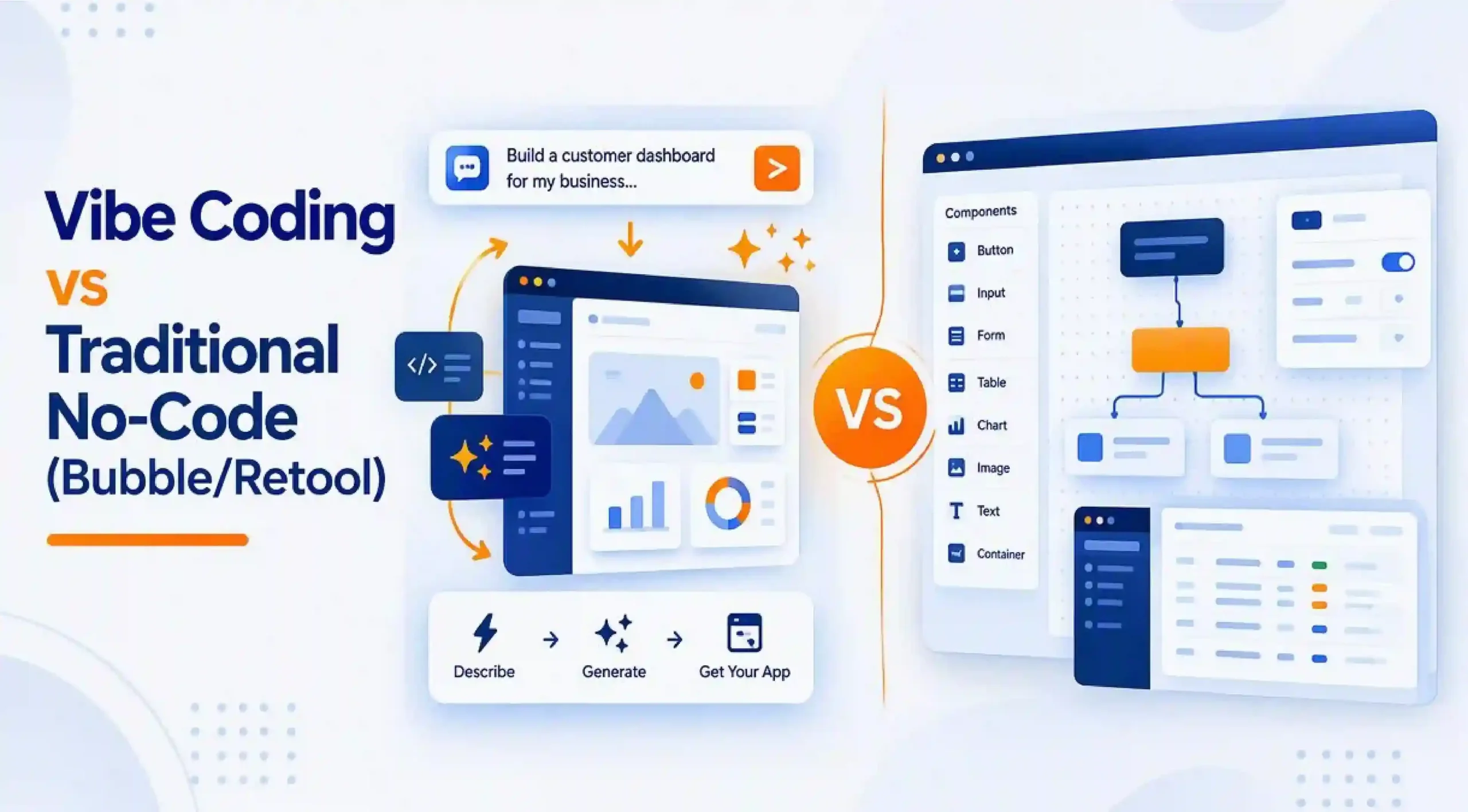
There has been a radical shift in the manner of software construction. Conventional development involved the manual writing and maintenance of application-level code by developers; no-code platforms like Bubble and Retool enabled the creation of apps using a visual interface. A new development model is being proposed by vibe coding: users define what they desire using natural language, and AI creates or rewrites the implementation behind the scenes, rather than creating an application by drag-and-drop.
This is critical as the different approaches address varying problems. Vibe coding puts far more control in the hands of the developers in the underlying software, whereas traditional no-code platforms will offer a controlled experience where developers can create apps but do not actually deal with an established codebase. Bubble is a web and mobile app development tool striving to build full-stack applications based on a visual programming environment, whereas Retool is notably effective with internal applications, dashboards, workflows, and business-connected applications.
Which should you pick- Vibe Coding, Bubble, or Retool? This does not require the answer to depend on the better technology and more on the type of thing you are constructing, who is going to maintain it, how much it needs customizing, and how much technical control your team needs.
What Is Vibe Coding?
Vibe coding involves an AI coding agent to convert natural-language instructions into real software. One can define a feature like a customer dashboard, authentication system, payment workflow, or API integration, and an AI code-generating tool will produce the required code and modify an existing project.
Contrary to traditional no-code systems, vibe coding typically generates a more traditional codebase which can be inspected, edited, tested, deployed, and ported across infrastructure providers. This provides more power to the architecture and implementation to those developers with more experience.
Flexibility is the key benefit. Should you require atypical business logic, a bespoke API, a database query tailored to your specialty, a complicated frontend interaction, or the host-specific implementation you would have to create with a visual builder, you are not really limited by the components that are provided. Nevertheless, this flexibility also implies that you can have the traditional on-top of software-development burdens, such as code review, testing, dependency management, security, deployment, and maintenance.
This difference is essential: vibe coding eliminates a lot of typing work in software development, but not software engineering.
What Is Traditional No-Code?
Conventional no-code platforms substitute a large part of typical programming with graphical development tools. Users configure workflows, database models, user interface components, permissions, and integrations instead of writing JavaScript, SQL, backend services, and frontend components manually.
A good example is Bubble, which offers graphical applications to create application interfaces, workflows, databases, integrations, and logic. The latter feature has been extended in Bubble now, which now offers AI generation; however, the generated application can still be visual and does not need a user to maintain a traditional codebase.
The focus of Retool is a little different. It has long been heavily oriented towards off-the-shelf tools, dashboards, administrator software, workflows, and data-linked business software. The newer AI app-generation features of its offerings boil down to integrating natural-language-generation systems with data relationships, security, governance, and code customization.
It signifies that no-code is not merely the reverse of AI development. The comparison gets more sophisticated as visual development + AI + optional code are more and more closely combined in contemporary platforms.
Vibe Coding vs Bubble
Bubble is especially useful when one desires to create a full application without having to be held accountable to a traditional software stack. Its graphic environment encompasses UI, database, workflows, integrations, hosting, and other infrastructure issues. Bubble offers AI-assisted generation and visual editing whereby users can begin with natural-language instructions before tuning the application in the visual editor.
Vibe coding offers an entirely new degree of control of implementation. Should you be fluent with React, Next.js, Python, Node.js, databases, APIs, cloud infrastructure, and Git, an AI software agent can assist you in writing applications not limited to the visual abstraction presented by Bubble.
Complexity is the tradeoff. Whereas with Bubble, much of the infrastructure is handled and the view of the logic of the application is provided. Under vibe coding, there is greater freedom.
Bubble could be a more realistic choice for a founder eager to create a marketplace in a short period of time, without recruiting a development team. Vibe coding is typically more flexible for a developer who is writing a highly customized SaaS product with atypical architecture needs.
Vibe Coding vs Retool
Retool takes another position, as it is specifically helpful when using it in applications that connect employees with databases, APIs, SaaS, and internal business processes. Areas of its platform include visual development, data connectivity, workflows, permissions, and more, including AI-powered application generation.
To illustrate this, suppose a business requires an in-house operational dashboard that displays customer data, payments, customer support tickets, inventory, and account history. This might be most fully customized by constructing it purely out of vibe coding, but would demand significant development and maintenance.
This kind of application can take Retool significantly faster since the platform is built on integrating interfaces with existing business systems. Its existing tooling similarly enables developers to leverage SQL, JavaScript, React, custom components, and AI-assisted generation, where more tailored control is needed.
In the case of internal tools, Retool will be much more productive than an empty codebase.
Vibe Coding vs No-Code: Key Differences
| Factor | Vibe Coding | Bubble | Retool |
| Development style | AI-generated code | Visual no-code | Visual + AI + code |
| Technical skill | Medium to high | Low to medium | Low to medium |
| Customization | Very high | High within platform | High for business apps |
| Code ownership | Usually full codebase | Platform-based | Platform-based with code capabilities |
| Best for | Custom products and SaaS | Web/mobile products | Internal tools and business apps |
| Backend control | Very high | Platform-managed | Platform-managed/integrated |
| UI flexibility | Very high | High | High |
| Infrastructure management | Developer responsibility | Mostly platform-managed | Platform-managed |
| Speed for prototypes | Very high | Very high | Very high |
| Long-term flexibility | Very high | Platform-dependent | Platform-dependent |
| Internal dashboards | Excellent | Good | Excellent |
| Complex custom systems | Excellent | More constrained | Good to excellent |
| Non-technical teams | Less suitable | Excellent | Excellent |
| Maintenance responsibility | High | Lower | Lower |
Which Approach Is Faster?
In simple applications, no-code can be significantly faster, since the platform already handles the infrastructure, data layer, authentication technology, user interface elements, and deployment environment. You are set up to configure an existing system, but not develop a complete software stack.
The more specific the requirements, the more appealing Vibe coding is. A seasoned developer can simply request an AI agent to adjust the specific component, API, database query, or service that requires adjustment instead of attempting to capture the need in terms of the controls that a visual builder presents.
Nonetheless, the speed of raw development should not be the sole factor. A five-day prototype which is hard to maintain may end up being more costly than a slightly slower implementation with a clean architecture.
Which Is Better for Production?
Production applications can be created using all three approaches, with their production strengths varying.
Bubble is a managed environment that has built-in application infrastructure as well as security. According to Bubble, its platform offers hosting, privacy options, security options, encryption, and security scanning, and enterprise plans offer further security options.
Retool is especially appealing to organizations requiring internal applications that have governance, authentication, connectivity to data, permissions, and operational controls. Its existing platform is all about safety, management, and AI-created applications.
The most control is in vibe coding, which comes with responsibility. You have to secure the application, manage dependencies, deploy infrastructure, set up deployment pipelines, track production, provide security, and maintain the generated code.
Vibe coding would not necessarily be more production-ready since it generates more conventional code. The engineering process establishes how good the application will be.
When Should You Choose Vibe Coding?
Use vibe coding when it is important to be as flexible and technical as possible. Especially compelling for developers, startups that have technical teams, and companies that develop products that might, later on, require custom architecture.
It will also come in handy when you have an established codebase. Instead of having to recreate the application within a no-code platform, the developers can have an AI coding agent operate within the existing folder and assist developers in expanding the software.
Vibe coding particularly works well in circumstances where the application has uncharacteristic needs, which would be hard to model visually.
When Should You Choose Bubble?
Bubble is an excellent option when the most essential aim is to release a whole web or mobile application without developing and maintaining a traditional software stack. It may be especially helpful with founders, product managers, agencies, and small teams that require advanced application functionality without the support of a large engineering organization.
Its AI generation and visual editing feature is also notable since users can create the first application in a short time, and then proceed to develop the UI, workflows, database, and privacy rules in a visual manner.
The main consideration is platform dependence. You are not only constructing a full-fledged, conventional codebase of your own, but rather working within the ecosystem of Bubble.
When Should You Choose Retool?
Retool is the more likely to be the more robust option when the application is mainly called into being as a way to assist a business, and not as a highly personalized consumer product.
Natural use cases include internal dashboards, administration panels, operations applications, customer-service applications, reporting systems, approval workflows, and data-management applications. Retool is designed to interconnect applications and business data and services, which could save a huge volume of duplicated development effort.
The fact that its recent AI functions implies that organizations do not necessarily need to decide between AI generation and platform governance. Visual editing and direct code customization can be more and more integrated into natural-language development by teams.
The Future Is Probably Hybrid
The most interesting development is that these categories are beginning to merge.
Vibe coding software is getting more formal, whereas no-code platforms are introducing AI agents and code options. Bubble has now merged AI creation and visual editing, and Retool enables groups to integrate AI-created software with code and enterprise governance.
This indicates that the future of software development may not necessarily be no-code/code. Rather, developers with the right abstraction of the different aspects of the product will be selected.
One example would be a company relying on Retool to run their business, Bubble as their fast-tested product, and a traditional codebase having AI code agents to run the fundamental technology that needs to be highly customizable.
Final Verdict
No universal victor exists amongst vibe coding, Bubble, and Retool. The two strategies have the benefits of being optimized to different tradeoffs of speed, control, technical complexity, and platform ease.
The most appropriate one is vibe coding in case flexibility and ownership are what is significant. Bubble will be best when you want to create a full application in a short time, without dealing with traditional code and infrastructure. Retool can really shine where you require internal tools to be linked to business systems and data.
The true wisdom is in how to employ all of them. No-code can very rapidly decrease the barrier to entry when what you need is to just prove a concept. When your product is too deep to be customized with traditional engineering architecture, vibe coding gives the developer a lot more to construct. And in case your company requires software to run, which is tied to the current databases and services, Retool can offer a much more effective avenue.
The future is not about the need to decide between AI and no-code, but rather the matter of applying the appropriate level of abstraction to any application.
Also Read: Is Vibe Coding Safe for Production Apps?
About the Author
